
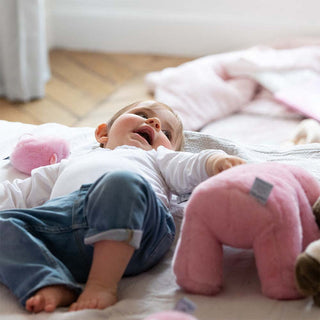
Sensory plushes offer a wide variety of features for baby to learn while having fun. Specifically designed for the sensory, cognitive, and motor development of babies from 6 months to 2 years old, these plushes are among the most popular developmental toys. So:
- What are their educational benefits?
- At what age will baby benefit from them the most?
- And most importantly, how do you choose a great developmental plush?
Let's get started without further ado!

What is a sensory plush?
Like any baby plush, sensory plushes, activity plushes, or developmental plushes, are often very soft and shaped like cute animals.
But they hold many surprises to awaken baby's interest and curiosity: bright colors, varied textures, funny sounds, small mirrors, tags to pull, etc.
Complementary to classic birth plushes, these developmental toys accompany and stimulate baby in discovering the world around them.
Read Also: 50 Unfailing Gift Ideas for 1-Year-Old Babies!
Awakening the senses!
A sensory plush or developmental plush primarily serves to stimulate baby's senses in a fun and reassuring way:
- Sight: contrasting colors and simple patterns attract baby's attention. Some models even have small mirrors or reflective elements to encourage visual exploration.
- Touch: almost all sensory plushes offer varied textures: soft fur, rough fabric, tags to pull, and many more. This allows baby to discover new tactile sensations.
- Hearing : some baby plushes even emit funny sounds thanks to bells, rattles, or melodies that stimulate baby's hearing and contribute to their musical awakening.
- Taste: although developmental plushes are not intended to develop our little ones' sense of taste, they will be happily chewed on! And this also contributes to sensory awakening.
- Smell: when made from natural materials, such as organic cotton or wood, sensory plushes also stimulate the sense of smell!
Fine motor skills
Imagine baby grasping their developmental plush with their whole hand for the first time, clumsily catching small objects, skillfully sliding a wooden ring, or determinedly pulling a protruding tag!
These playful activities help strengthen baby's small arm and hand muscles, improve their hand-eye coordination, dexterity, and grasping ability. Baby learns to control their movements and refine their reflexes. And let's be honest: it's better for them to practice on their plush than on the dishes!
Cognitive development and social interaction
Like all plushes, sensory developmental plushes are also good allies for baby's cognitive and social development. By playing with their plushes, a newborn is encouraged to explore their environment, experiment, imagine, and give free rein to their natural creativity.
The various activities offered stimulate their memory and reasoning, as well as help them understand cause-and-effect relationships. It's excellent training for their growing brain!
And that's not all: baby plushes are ideal partners for developing social skills and interactions. By playing with their plushes, baby learns to share, communicate, and build relationships with others.

At what age should you offer a developmental plush?
Soft toys are among children's favorite toys, from birth to adulthood. So there's no age limit for offering a plush.
However, a plush adapted to the baby's age will better support their development and fulfillment.
Thus, sensory plushes and activity plushes are ideal for children between 6 months and 2 years old. Before that, soft birth comforters are preferred, and later, more realistic plushes.
From 0 to 6 months: the birth comforter
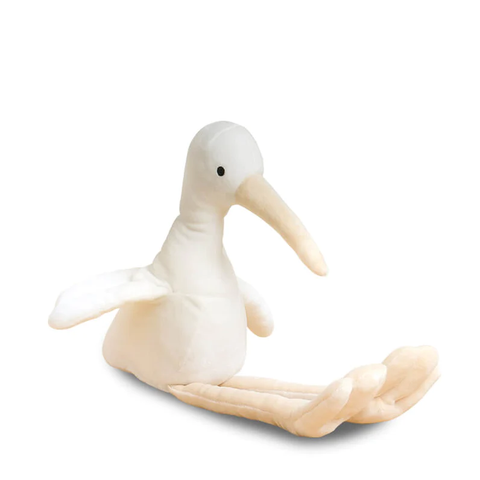
My First Stork Comforter, La Pelucherie
Offering a developmental plush to a baby under 6 months old is not very useful. Baby is still too small to enjoy it. They will prefer a birth comforter, the perfect companion for newborns.
Soft and reassuring, these small plushes shaped like a stork, bear, rabbit, dog, or donkey for the more original ones, help baby fall asleep peacefully, recalling the safety and warmth of mom's womb.
Read Also: How to Find the Ideal Birth Comforter for Baby!
From 6 months to 2 years: developmental plushes
Between 6 months and 2 years, it's the ideal age to offer developmental plushes. Baby becomes more active and begins to curiously explore their environment and develop their fine motor skills. They are then gradually able to grasp their plushes, manipulate them, and fully enjoy the sensory activities offered!
After 2 years: more realistic plushes

My Dog Hector Plush, La Pelucherie: Realistic Plushes with a Lifetime Guarantee!
From 2 years old, children begin to be interested in more realistic plushes, representing animals or characters from their favorite stories. These plushes then serve as play companions around which the child invents stories and develops their overflowing imagination.
"Real" plushes are often larger and more robust than developmental plushes for baby, allowing children to use them for many years. They then become true friends!

How to choose the right developmental plush for baby?
Not all developmental plushes are created equal! Some are much more beneficial for baby's development than others. So, how do you find the rare gem?
First, listen to your baby! What currently catches their attention: Colors? Anything shiny? Things that make noise? Things they can chew on? It's important to adapt to your baby's tastes and developmental pace, because let's not forget: they're the boss!
Then, think safety and avoid "made in China." Before 3 years old, baby puts everything in their mouth. It is imperative to choose a developmental plush that presents no risk of choking or toxicity. Opt for high-quality plushes, free of chemicals and preferably made of natural materials (organic cotton, wood). And be careful with small elements that could detach and end up in baby's mouth!
Admittedly, the best developmental plushes are generally more expensive than others, but they're worth it!
Read Also: How to Properly Store Your Plushes?
How to introduce developmental plushes to your baby?
It is generally recommended to offer several sensory developmental plushes to baby to vary the program and continuously rekindle their interest. As soon as boredom sets in, introduce a new educational plush to offer new experiences.
When you offer a new plush, don't hesitate to play with your baby to show them how to use it. They will observe you carefully to imitate your gestures when it's their turn.
Caution: sleeping with a developmental plush is not recommended. As their name suggests, these plushes are designed to awaken and stimulate baby, not to relax and put them to sleep. It is therefore preferable to have developmental plushes for playing, and a soft comforter for falling asleep!
And you? What do you think of developmental plushes? How did you choose those for your babies?